

From monolith to microservices: a migration guide
How to migrate from a monolithic architecture to microservices without interrupting operations: the Strangler Fig pattern, anti-corruption layers, data decoupling and lessons from Netflix, Amazon, Spotify and Uber.

1. The journey from monolith to microservices
The evolution of software architecture has pushed organisations to re-evaluate their systems in search of greater agility, scalability and resilience. In that context, moving from a monolithic architecture to microservices has become a strategic imperative for many modern companies.
A monolithic architecture is a software design pattern in which every component of an application is tightly integrated into a single unit. The user interface, the business logic and the database interactions all live in one codebase and are deployed as a single entity. This traditional approach is straightforward for rapid prototyping and smaller applications early on, but it presents significant challenges as the system grows.
A microservices architecture, by contrast, is an architectural style that structures an application as a collection of small, autonomous, loosely coupled services. Each one runs in its own process, is built around a specific business capability and can be deployed independently, communicating through lightweight mechanisms such as HTTP APIs. That modularity promises far greater flexibility in both development and deployment.
The core promise of microservices lies in the agility and scalability they enable. They allow individual components to be scaled on demand, new features to be shipped faster and fault tolerance to improve — all of which matter enormously for large, complex applications seeking greater efficiency and a quicker response to market dynamics.
The road to microservices is not free of obstacles, however. Transforming a monolith into microservices is an ambitious project that demands meticulous planning and execution, particularly when the goal is to avoid interrupting systems already running in production. The migration has to guarantee business continuity, which is the paramount objective for any organisation.
There is a paradox in monolithic architecture: its initial simplicity often becomes the source of its future complexity. In the beginning, monoliths are easier to develop, allow for rapid prototyping and carry lower upfront costs thanks to their unified nature. But as the application expands, that same simplicity turns into a bottleneck. Scalability becomes constrained, development slows down, maintenance grows harder and the risk of system-wide failure rises considerably. This dynamic illustrates how an architectural choice that is initially advantageous for a small project can inherently generate significant challenges and limitations as the system grows, making migration an evolutionary necessity.
It is also essential to understand that migrating to microservices is a business strategy, not merely a technical decision. Organisations do not adopt microservices purely for their technical characteristics; they do so as a strategic move to achieve greater flexibility, scalability and resilience, and to accelerate time to market for new products and features. Implementing microservices often requires deep cultural and organisational change. The success of a migration is therefore intrinsically tied to aligning the technical effort with broader commercial objectives, and to the organisation's cultural readiness to adopt new ways of working.
2. Why undertake the migration? A closer analysis
Deciding to migrate from a monolithic architecture to microservices requires a thorough assessment of the advantages and drawbacks of each approach, along with a clear understanding of when the moment is right to begin.
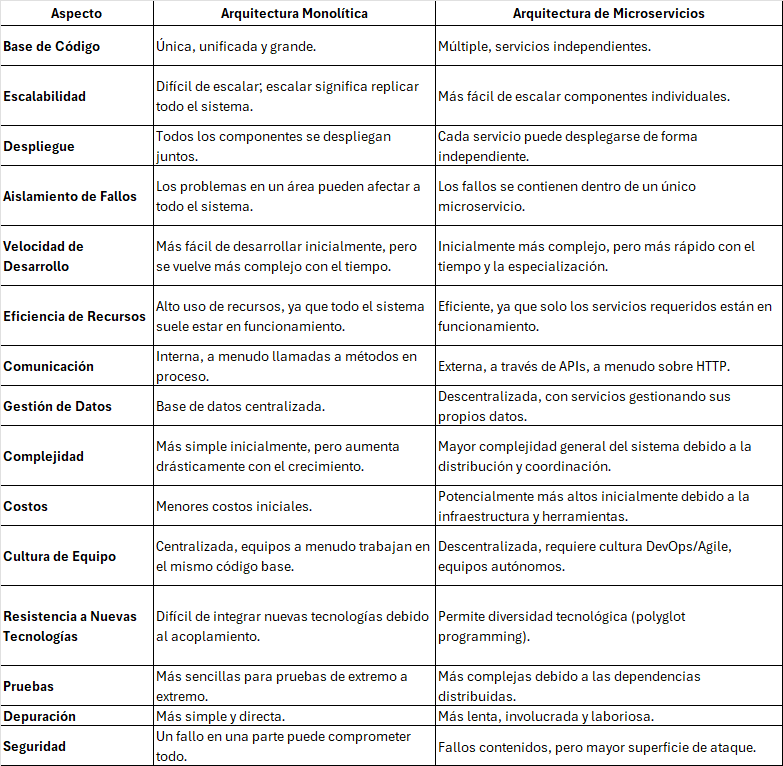
Advantages and disadvantages of monolithic architecture
Despite its limitations at scale, monolithic architecture has characteristics that make it attractive in certain scenarios.
Advantages:
- Fast initial development and deployment: For small applications or startups with limited functionality, the simplicity of a unified design allows for agile development and deployment in the early stages.
- Straightforward testing: Because it is a single application, end-to-end testing is more direct and runs from a centralised logging system, which simplifies error detection.
- Fewer communication complexities: Components communicate through in-memory calls, eliminating the challenges inherent to distributed systems, such as network latency or service failures.
- Low upfront costs: Centralising the codebase and the infrastructure reduces the initial investment in both resources and configuration.
Disadvantages:
- Limited scalability: As applications grow, monolithic architecture becomes harder to scale. It requires replicating the entire system even when only one specific function is under heavy demand, which results in inefficient resource use.
- Slower development cycles over time: As the codebase grows, the complexity of adding features, fixing bugs or implementing changes increases, leading to slower development cycles.
- Difficult maintenance and high risk of failure: A large, monolithic codebase is challenging to maintain, especially with multiple developers. Changes in one area can inadvertently break another, and a failure in one part of the system can bring down the entire application.
- Resistance to new technologies: Because of the tight coupling, integrating new technologies or programming languages into an existing monolithic application can be difficult.
Advantages and disadvantages of microservices architecture
Microservices architecture emerged as a response to the limitations of monoliths, offering a distinct set of benefits and challenges.
Advantages:
- Greater efficiency and lower long-term costs: Microservice-based applications are simpler and more efficient to maintain and update. Their modular nature allows new features or bug fixes to be deployed without compromising the rest of the system.
- Scalability on demand: Microservices scale horizontally without friction, which makes them ideal for large, complex systems where scalability is a priority. This makes it easier to react to traffic spikes and keeps the overall system stable.
- Improved fault tolerance: They are more fault tolerant than monoliths, since smaller, modular services can be deployed and managed independently. If one service runs into trouble, it does not take down the whole application.
- Higher developer productivity: Developers can work on smaller modules without needing deep knowledge of the entire system, which simplifies onboarding and enables multiple teams to develop in parallel.
- Agility in testing and deployment: Each microservice is relatively simple, which allows it to be tested individually before integration, minimising complexity and debugging time. They also deploy far more quickly.
- Technological diversity (polyglot programming): Teams can use different technologies and programming languages suited to the specific needs of each service, encouraging innovation and experimentation.
Disadvantages:
- Greater overall system complexity: Although individual services are simpler, the system as a whole has more moving parts, making it more complex to manage, monitor and debug. It demands considerable effort in planning and automation.
- Cultural and organisational change required: Adopting microservices successfully demands a mature DevOps and Agile culture, with autonomous teams and decentralised decision-making — a significant challenge for many organisations.
- Potentially higher upfront costs: Each isolated service requires its own resources (CPU, runtime environment) and tooling, which can increase resource demand and initial costs compared with a monolith.
- Security challenges: The proliferation of containers and the greater volume of data exchanged between modules expand the attack surface and introduce significant security challenges.
- Network latency and congestion: Communication between services over the network introduces latency and the need to design APIs carefully to avoid excessively "chatty" calls.
- Distributed data management: Maintaining data consistency across multiple databases (often following a BASE rather than an ACID model) is a complex challenge that requires specific patterns.
- Harder testing and debugging: Debugging is slower, more involved and more laborious because it requires verifying dependencies, caching behaviour and data access across a distributed system.
When is the right time to migrate?
The decision to migrate to microservices should not be taken lightly. It is most appropriate when the monolithic application has become too complex, too hard to maintain or too difficult to scale to meet growth demands. It also becomes necessary when there is a critical need for greater agility, faster deployment and quicker responsiveness to market changes and business needs. If scalability requirements cannot be met efficiently by the monolith, and only specific parts of the application need to scale, microservices offer a more efficient solution. Finally, when the goal is to make optimal use of modern technologies, containerisation or cloud infrastructure, a microservices architecture aligns better with those objectives.
It is worth stressing that not every project needs microservices. Small or medium-sized applications, projects with tight deadlines or teams with limited resources may well find that a monolithic approach is more than sufficient and more efficient. The architectural choice should be based on the specific needs of the business and the capabilities of the team.
One crucial factor to consider is the "hidden cost" of microservice complexity. While microservices promise agility and scalability, they introduce a new class of problems related to managing distributed systems. That complexity translates into enormous effort, careful planning and the strategic application of automation for communication, monitoring, testing and deployment. Lack of governance, along with network congestion and added latency, are inherent challenges. Without a solid DevOps culture, managing numerous services can quickly become unmanageable. This cost is not only financial but also operational, in terms of overhead and team coordination, and it can cancel out the benefits if not handled properly — leading to what some have called a "distributed monolith".
Migrating to microservices is often a symptom of an application's growth and maturity. Monolithic architectures are well suited to small and medium-sized applications and to early-stage use. But as applications grow, expand or face heavier load, the limitations of the monolith become evident and drive the need for transformation. This suggests that migration is, in many cases, a necessary evolutionary step for successful, growing applications that have outgrown their initial architectural constraints. It is a sign of maturity and increased demand rather than a flaw in the original architectural choice.
There is a trap in adopting microservices without a clear, well-defined need. Implementing microservices without a specific business problem to solve, or without the necessary organisational and cultural maturity (such as a DevOps culture and autonomous teams), can produce worse outcomes than staying with a well-structured monolith. A notable example is Amazon Prime Video, which initially adopted microservices for its video quality analysis team and later reverted to a monolithic architecture, achieving a 90% reduction in operating costs along with greater efficiency. This underlines that microservices are not a universal solution, and that adopting them must be driven by specific business needs and accompanied by proper organisational preparation.
3. Core strategies for a transition without interruptions
Migrating from a monolith to microservices, particularly when minimising downtime is the goal, requires applying proven architectural strategies and patterns. Two of the most influential approaches in this process are the Strangler Fig pattern and anti-corruption layers.
The Strangler Fig pattern: incremental, safe replacement
The Strangler Fig pattern, coined by Martin Fowler, draws on the analogy of the strangler fig, which grows around a host tree until it consumes and completely replaces it. In software terms, the pattern involves building a new application — made up of microservices — around the existing monolith. The key is to gradually intercept requests aimed at the monolith and redirect them to the new services, until the legacy system can be safely decommissioned.
The pattern unfolds in several stages. First, a facade is introduced between the client and the monolith; this can be a proxy or an API Gateway. The facade acts as an intermediary that initially routes most requests to the monolith, preserving existing functionality and ensuring operational continuity. As new microservices are developed for specific capabilities, the facade begins redirecting the corresponding requests to those new services. The process is iterative and gradual, which allows the existing system to keep running throughout modernisation and significantly reduces the risk associated with a "big bang" migration. Once all functionality has been migrated and no dependencies on the legacy system remain, the monolith can be safely decommissioned and the facade removed so the client talks directly to the new system.
The key benefits of the Strangler Fig pattern for achieving a zero-downtime migration are considerable. First, it dramatically reduces risk by allowing small components to be migrated in isolation, minimising system impact and enabling continuous testing and iteration along the way. Second, it guarantees continuous operation, since the legacy system remains live throughout the modernisation effort, ensuring business continuity and minimising disruption for end users. Finally, the pattern encourages flexibility and agility, allowing migrated microservices to be released without pausing or redesigning the entire system, which accelerates the pace of innovation.
This pattern acts as a fundamental enabler of "continuous migration". The requirement not to interrupt operations is met precisely through this approach. Descriptions of the Strangler Fig pattern consistently present it as an incremental, gradual, phased and lower-risk method that lets the existing application keep running, or guarantees minimal interruption and continuous operation. It is therefore not just a migration pattern but the primary strategy that makes the zero-downtime objective achievable. It turns a high-risk, big-bang migration into a series of continuous, manageable deployments, which aligns perfectly with DevOps principles of continuous delivery.
Anti-corruption layers (ACL): protecting the integrity of your new services
Anti-corruption layers (ACLs) are a crucial migration pattern, originating in Eric Evans' Domain-Driven Design (DDD) approach. Their importance comes from the fact that new microservices must interact with a legacy monolithic system that often carries inconsistent, impoverished or highly domain-specific data models and logic. The main goal of an ACL is to protect new systems from inheriting poor design decisions or inconsistent models from the legacy.
An ACL works by introducing a translation layer between the new microservices and the legacy system. That layer acts as an adapter or facade that transforms the monolith's data structures and logic into a format that is easier to manage and more consistent for the microservices. This ensures the microservices do not need to understand the internal complexity or idiosyncrasies of the legacy system. In doing so, the ACL shields the microservices from inheriting the legacy system's complexity or problematic design decisions, keeping the new design clean and modular.
The advantages of implementing an ACL are significant. It isolates microservices from the distorted designs caused by interacting with the legacy system, allowing each microservice to preserve its integrity rather than adapting to the monolith's complexities. This makes for a smoother migration, since microservices can integrate with legacy systems without modifying their own internal logic.
Implementing an ACL is a critical step in decoupling the new system's domain from the legacy system's domain. Legacy systems often carry data models and logic that are the result of years of evolution, patches and compromises, which makes them hard to understand and even harder to integrate cleanly with modern architectures. An ACL addresses this by creating a buffer that translates the monolith's concepts and data into a language the new microservices can understand and use consistently. This is fundamental to preventing legacy "rot" from spreading into the new microservices ecosystem, ensuring the new services are genuinely clean and modular from the outset. Without an ACL, new microservices might be forced to embed complex translation logic or adopt inconsistent data models, undermining the benefits of the microservices architecture and creating a "distributed monolith".
4. The migration process in detail: a step-by-step approach
Migrating from a monolith to microservices is a complex journey that, to succeed without interruptions, must follow a structured and methodical process. That process can be divided into key phases, each with its own steps and considerations.
Phase 1: assessment and strategic planning
Before writing a single line of code, it is crucial to understand the existing system thoroughly and define a clear roadmap.
- Thorough analysis of the monolith: Start with a deep analysis of the existing monolithic application, understanding its structure, dependencies and functionality. This means identifying every component, how they interact and where the performance bottlenecks or maintenance complexities lie.
- Identifying bounded contexts (DDD) and microservice candidates: Using Domain-Driven Design principles, identify the bounded contexts within the monolith. These are the cohesive modules with well-defined boundaries that are ideal candidates to become independent microservices. Each microservice should focus on a single business capability.
- Prioritising components: Not everything should be migrated at once. Decide the extraction order based on factors such as complexity, dependencies, business value and rate of change. It is advisable to start with less complex or more isolated functionality.
- Setting clear objectives and success metrics: Define what the migration is expected to achieve and how success will be measured. This helps avoid the trap of migrating without a clear need, and ensures the effort aligns with tangible business outcomes.
- Organisational and cultural preparation: Migration is not only a technical change; it demands cultural transformation. The team needs to be prepared for a DevOps and Agile culture, encouraging autonomy, accountability and collaboration across teams. This may involve restructuring teams so they own services end to end.
Phase 2: preparing the infrastructure and the DevOps environment
A robust DevOps environment is fundamental to a successful migration and to managing microservices.
- Setting up CI/CD pipelines: Establish automated continuous integration and continuous deployment pipelines for the new microservices. Each microservice should have its own isolated, versioned pipeline to allow independent deployments.
- Adopting containerisation and orchestration: Use tools such as Docker to package each microservice into containers, ensuring consistency and portability. To manage and scale those containers, implement orchestration platforms such as Kubernetes or Amazon ECS.
- Implementing monitoring, logging and distributed tracing: Establishing a comprehensive observability system is critical for distributed systems. This includes monitoring tools (Prometheus, Grafana, Datadog), centralised logging (the ELK stack) and distributed tracing (OpenObserve, AWS X-Ray, Jaeger, Zipkin) to gain visibility into performance, errors and interactions between services.
- Setting up an API Gateway and a Service Mesh: As the number of services grows, managing communication becomes complex. An API Gateway (such as Amazon API Gateway or Kong) acts as a centralised entry point for clients, handling routing, authentication, authorisation and rate limiting. A Service Mesh (such as Istio or Linkerd) manages service-to-service communication, providing service discovery, load balancing, traffic management, security (mTLS) and observability without modifying application code.
Phase 3: incremental implementation with the Strangler Fig pattern
This phase is the heart of an uninterrupted migration.
- Developing the first microservice: Select a non-critical, loosely coupled piece of functionality for the first microservice. This lets the team become familiar with the new paradigm and establish the minimum necessary DevOps architecture.
- Implementing the Strangler facade: Create the intermediate layer (a proxy or API Gateway) that will intercept calls to the monolith and route them to the new microservice or to the monolith as required.
- Migrating functionality and routing traffic: Begin moving functionality from the monolith to microservices, one piece at a time. As each piece is replaced, update the routing rules in the Strangler facade to redirect requests to the new microservice.
- Using feature flags for controlled rollouts: Feature flags are essential to incremental migration. They allow new functionality to be switched on or off without redeploying code, which enables progressive rollouts, testing in production (canary testing) and rapid rollbacks if problems arise.
Phase 4: data management and database decoupling
The monolithic database is often the hardest component to decouple.
- Data migration and synchronisation strategies: Plan the data migration strategy carefully. This may involve temporarily duplicating data or initially implementing a shared database pattern. Real-time data synchronisation between the monolith and the new microservices is critical to maintaining availability, often using Change Data Capture (CDC) with tools such as AWS DMS.
- Distributed data management patterns: As microservices decouple, each one should be responsible for persisting its own data. This can lead to adopting patterns such as "Database per Service". To maintain data consistency across multiple services, patterns such as Saga (for distributed transactions) or Event Sourcing (for capturing state changes as a sequence of immutable events) can be employed.
- Progressively decoupling the monolithic database: Gradually transferring ownership of data from the monolith to the respective microservices is a critical step. This is often done through dual-read and dual-write strategies, or read-through caching, to ensure the new services can access data while it is being migrated. Eventually the monolithic database is decoupled and decommissioned.
Phase 5: rigorous testing and quality assurance
Testing in a microservices environment is more complex and requires a multi-faceted approach.
- Unit testing: To ensure the smallest units of code within a service behave as expected.
- Component testing: To verify that a given service works correctly by isolating it and replacing its dependencies with test doubles.
- Integration testing: To validate that independently developed components or microservices work correctly when connected, exercising the communication paths.
- Contract testing: To ensure compatibility between services by verifying that APIs honour the agreed contracts.
- End-to-end testing (E2E): To test the complete application flow from the user's perspective, simulating real-world scenarios. These are reserved for ultra-critical flows because of their complexity.
Automation is key to speed and reliability in a microservices environment, enabling faster feedback loops. It is also worth creating dedicated test environments that replicate production as faithfully as possible, allowing exhaustive testing without affecting the live system.
Phase 6: continuous deployment and release strategies
The ability to deploy changes quickly and safely is a cornerstone of microservices.
- Automated CI/CD pipelines: Reinforce and optimise the pipelines to allow automatic, frequent deployments of each microservice.
- Canary deployments: Deploy the new version to a small percentage of users and monitor its behaviour before a full release. This reduces risk and allows problems to be detected early.
- Blue/green deployments: Maintain two identical environments. One runs the current version (blue) and the other the new one (green). Once the green version is validated, traffic is switched instantly to the new environment. If problems appear, you can revert to blue quickly.
- Rolling updates: Deploy the new version gradually across a subset of instances, replacing the old version incrementally. This minimises downtime, although a mix of old and new versions may run temporarily.
- Rollback mechanisms: Having a well-defined, automated rollback plan is essential. This includes keeping previous deployment versions available for quick reversion and, where database changes are involved, reversible migration scripts or strategies such as point-in-time recovery.
Phase 7: monitoring, optimisation and ongoing maintenance
Migration does not end with the first microservice deployment; it is a continuous process.
- Proactive monitoring and observability: Continuously monitoring each microservice and its interactions is vital to ensuring performance and stability and to detecting anomalies early.
- Performance optimisation: Continuously monitor and tune the performance of the new microservices, refactoring and optimising as needed to improve scalability and maintainability.
- Updating documentation and transferring knowledge: Keep documentation current so it reflects the new architecture and the changes made. Ensure the development team is trained in maintaining and developing the microservices architecture.
- Gradually decommissioning the monolith: Once all functionality has been migrated and validated, the monolith can be safely decommissioned piece by piece, ensuring business capabilities are not affected. This includes the final decoupling and dismantling of the monolithic database.
5. Case studies: lessons from industry leaders
Numerous leading companies have undertaken the migration to microservices, offering valuable lessons and demonstrating both the benefits and the challenges of this transformation.
Netflix. Netflix is a pioneer and one of the most frequently cited examples of microservices adoption. Its DVD rental service originally ran as a monolithic application, which limited the flexibility and speed its growing streaming service required. From 2009 onwards, the company began migrating its architecture to microservices on AWS. It used the Strangler Fig pattern to gradually move different parts of the streaming platform into microservices, starting with non-critical components and using API Gateways and load balancers to allow old and new systems to coexist. The strategy let Netflix scale smoothly and innovate without interrupting service for millions of users, handling massive traffic and accelerating organisational development. One key lesson from Netflix was the importance of a separate data store for each microservice, to avoid unintended coupling and to allow the right database to be chosen for each need.
Amazon. Amazon pioneered the evolution of distributed architectures, moving from a monolith to a service-oriented architecture and then to microservices, before those terms even existed. In 2001, the Amazon.com retail website was a large architectural monolith with tightly coupled services and components. The shared database became a bottleneck for innovation. Around 1998, Amazon engineers laid the groundwork for a radical overhaul, moving towards a three-tier architecture that separated presentation, business logic and data. This meant encapsulating business logic behind well-defined interfaces, decoupling clients from the underlying data structure and allowing services to evolve independently. The shift required a more disciplined approach to software engineering and a change of mindset among developers — from a data-centric focus to one of modelling data relationships and designing client-server interfaces that do not expose the underlying data model. That said, the Amazon Prime Video case, in which a team reverted from microservices to a monolith for video quality analysis and achieved a 90% reduction in operating costs, demonstrates that architectural choices must be carefully evaluated against specific needs, and that microservices are not always the optimal solution.
Spotify. With more than 75 million monthly active users and steady growth, Spotify needed a solution that could scale to millions of users, support multiple platforms and handle complex business rules. Adopting microservices allowed it to meet those requirements by structuring the application into loosely coupled parts — a prerequisite for its model of autonomous, full-stack teams. Each microservice was designed around specific business capabilities, such as playlist management or recommendation algorithms. This allowed teams to iterate quickly and add features without affecting other parts of the system. Spotify also benefited from independent scalability: during usage peaks, only the services that needed it were scaled, avoiding over-provisioning. The ability to experiment and run A/B tests on specific features without worrying about the impact on the whole application was another key benefit. Despite those benefits, the company faced challenges such as synchronisation between components, the complexity of overall monitoring given hundreds of services (more than 810 active) and the need for good documentation and discovery tooling.
Uber. Uber's adoption of microservices was driven by the challenges of its monolithic services around 2012–2013, as the company grew exponentially. Availability risks, expensive and risky deployments, poor separation of concerns and inefficient team execution were key motivators. The initial transition to microservices improved system reliability, separation of concerns, clarity of code ownership and team autonomy, which increased developer velocity. However, as Uber grew to thousands of engineers and 2,200 critical microservices, new complexities emerged: greater system complexity, difficulty understanding dependencies, debugging challenges, cross-service work for new features, compromised ownership and the creation of "distributed monoliths" in which nominally independent services had to be deployed together. To address this, Uber introduced Domain-Oriented Microservice Architecture (DOMA), which organises microservices into domains (collections of related services) and layers (collections of domains with specific dependency rules). It also implemented gateways as single entry points to domains, and extensions to extend logic or data without changing core implementations. DOMA aims to turn complex microservice architectures into a structured set of flexible, reusable, layered components, simplifying the developer experience and reducing overall system complexity.
A financial services case. A financial services company faced significant challenges with its monolithic CRM system, which suffered degraded performance due to new modules, exponential user growth and complex data flows. The outdated codebase made maintenance difficult and hiring developers complicated. System complexity and a database of more than 2.5 terabytes made it hard to create dedicated test environments, which meant risky testing in production. The solution involved a phased migration, beginning by extracting heavy jobs and moving them to new cloud infrastructure, relieving load on the monolith and improving performance. The technology stack was overhauled, with critical services rewritten and part of the existing code ported across. The migration is an ongoing process, but it has already produced a significant reduction in system load and a marked improvement in performance. This case underlines the importance of identifying the most critical pain points and addressing them incrementally to achieve immediate, sustainable impact.
6. Conclusions and key recommendations
Transforming a monolithic architecture into microservices is a strategic and complex journey, but one that offers substantial rewards in agility, scalability and resilience for growing organisations. The key to a successful migration — especially one that does not interrupt operations — lies in meticulous planning, the adoption of proven patterns and a deep cultural transformation.
It is not a universal cure. Adopting microservices is not a universal solution to every software problem. While it offers significant benefits for large, growing systems, it can introduce additional complexity that, if not managed with the right tools and culture, can cancel out its advantages. The decision to migrate should be driven by clear, quantifiable business needs, not by following a trend.
Complexity moves; it does not disappear. A monolith's complexity shows up in its sheer size and coupling. In microservices, that complexity becomes the management of a distributed system, requiring considerable effort in orchestration, communication, observability and data consistency. The hidden cost of this distributed complexity demands significant investment in automation and mature DevOps practices.
Migration is an evolutionary process, not a single event. The case studies show that the transformation is a continuous journey, often incremental and phased, that can take years. It is not a "big bang" but a series of small, controlled steps that allow the monolith and the microservices to coexist over an extended period.
Actionable recommendations for an uninterrupted migration:
- Define the business strategy and clear objectives. Before any technical change, establish why you are migrating and which business problems will be solved. Success metrics should be quantifiable and aligned with organisational goals.
- Adopt an incremental approach with the Strangler Fig pattern. This pattern is fundamental to a zero-downtime migration. Start by extracting less critical, loosely coupled functionality, gradually building the new services around the existing monolith and redirecting traffic in a controlled way.
- Invest in a robust DevOps culture. CI/CD automation, proactive monitoring, centralised logging and distributed tracing are non-negotiable pillars for managing microservice complexity. Organisations should foster autonomous teams and an end-to-end service ownership mindset.
- Manage data decoupling precisely. The monolithic database is the biggest challenge. Plan data migration and synchronisation strategies that guarantee consistency, using patterns such as "Database per Service" and mechanisms such as Change Data Capture and API Gateways for communication.
- Prioritise observability and continuous testing. Implementing comprehensive monitoring from the outset and establishing a multi-faceted testing strategy is crucial to detecting and resolving problems quickly in a distributed environment.
- Use advanced deployment strategies. Employ techniques such as canary and blue/green deployments, together with feature flags, to release new functionality progressively and at low risk, allowing instant rollbacks when needed.
- Encourage adaptability and continuous learning. Microservices architecture is inherently evolutionary. Organisations must be ready to continuously refactor, optimise and adapt their services and processes as business needs and technology evolve. Documentation and knowledge transfer are vital to sustaining this.
In short, migrating from a monolith to microservices is a profound transformation that goes beyond technology, affecting organisational culture and processes. By approaching the journey with a clear strategy, an incremental method and a commitment to operational excellence, companies can achieve a more agile, scalable and resilient architecture — one capable of driving innovation and growth without interruption.